

Skip to content
VirtualCancerCure

VirtualCancerCure

Home of CancerMate: computational prognosis of neoadjuvant therapies for breast cancer

  • Home
  • Contact the CancerMate Team
  • About Us
  • Home
  • 2025
  • December
  • From Equations to Tumour Dynamics
holo-popup

From Equations to Tumour Dynamics

Posted on December 16, 2025September 30, 2026 By admin
Info on the Software

CancerMate does not treat mathematics as magic or as a black box. Its equations provide a simplified, testable representation of biological processes occurring at tissue scale.

Reaction-diffusion equations describe the balance between tumour proliferation, spatial transport and treatment effects. Model parameters can be informed by diagnostic imaging and selected biological measurements, allowing the simulation to reflect characteristics of the patient and treatment setting under study.

The resulting calculations estimate how a tumour-related quantity may evolve over time. Depending on the study, that quantity may represent metabolic activity or lesion volume; these measurements cannot be treated as interchangeable.

Every mathematical model depends on assumptions, parameter choices and available data. Its results must therefore be compared with observations and interpreted within a clearly defined context of use. One has, in particular:
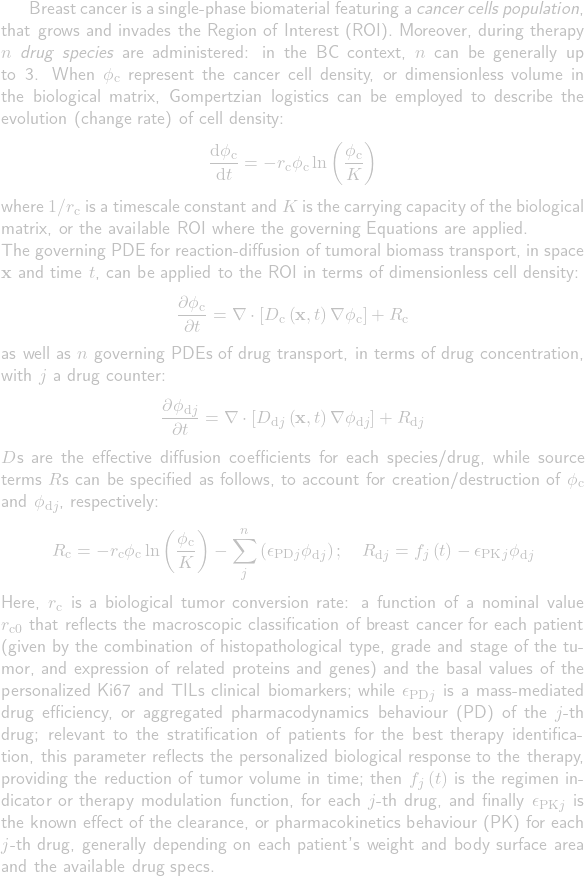
    Breast cancer is a single-phase biomaterial featuring a \emph{cancer cells population}, that grows and invades the Region of Interest (ROI). Moreover, during therapy $n$ \emph{drug species} are administered: in the BC context, $n$ can be generally up to 3. When $\phi_\mathrm{c}$ represent the cancer cell density, or dimensionless volume in the biological matrix, Gompertzian logistics can be employed to describe the evolution (change rate) of cell density:\begin{equation*}\frac{\mathrm{d}\phi_\mathrm{c}}{\mathrm{d}t}=-r_\mathrm{c}\phi_\mathrm{c}\ln\left(\frac{\phi_\mathrm{c}}{K}\right)\end{equation*}where $1/r_\mathrm{c}$ is a timescale constant and $K$ is the carrying capacity of the biological matrix, or the available ROI where the governing Equations are applied.\\The governing PDE for reaction-diffusion of tumoral biomass transport, in space $\mathbf{x}$ and time $t$, can be applied to the ROI in terms of dimensionless cell density:\begin{equation*}\frac{\partial\phi_\mathrm{c}}{\partial t}=\nabla\cdot\left[D_\mathrm{c}\left(\mathbf{x},t\right)\nabla\phi_\mathrm{c}\right]+R_\mathrm{c}\end{equation*}as well as $n$ governing PDEs of drug transport, in terms of drug concentration, with $j$ a drug counter:\begin{equation*}\frac{\partial\phi_{\mathrm{d}j}}{\partial t}=\nabla\cdot\left[D_{\mathrm{d}j}\left(\mathbf{x},t\right)\nabla\phi_{\mathrm{d}j}\right]+R_{\mathrm{d}j}\end{equation*}$D$s are the effective diffusion coefficients for each species\slash drug, while source terms $R$s can be specified as follows, to account for creation\slash destruction of $\phi_\mathrm{c}$ and $\phi_{\mathrm{d}j}$, respectively:\begin{equation*}R_\mathrm{c}=-r_\mathrm{c}\phi_\mathrm{c}\ln\left(\frac{\phi_\mathrm{c}}{K}\right)-\sum_j^n\left(\epsilon_{\mathrm{PD}j}\phi_{\mathrm{d}j}\right);\quad R_{\mathrm{d}j}=f_j\left(t\right)-\epsilon_{\mathrm{PK}j}\phi_{\mathrm{d}j}\end{equation*}Here, $r_\mathrm{c}$ is a biological tumor conversion rate: a function of a nominal value $r_\mathrm{c0}$ that reflects the macroscopic classification of breast cancer for each patient (given by the combination of histopathological type, grade and stage of the tumor, and expression of related proteins and genes) and the basal values of the personalized Ki67 and TILs clinical biomarkers; while $\epsilon_{\mathrm{PD}j}$ is a mass-mediated drug efficiency, or aggregated pharmacodynamics behaviour (PD) of the $j$-th drug; relevant to the stratification of patients for the best therapy identification, this parameter reflects the personalized biological response to the therapy, providing the reduction of tumor volume in time; then $f_j\left(t\right)$ is the regimen indicator or therapy modulation function, for each $j$-th drug, and finally $\epsilon_{\mathrm{PK}j}$ is the known effect of the clearance, or pharmacokinetics behaviour (PK) for each $j$-th drug, generally depending on each patient's weight and body surface area and the available drug specs.

Post navigation

❮ Previous Post: Virtual Human Twins and In Silico Medicine
Next Post: CancerMate’s Interface and User Manual ❯

You may also like

Info on the Software
CancerMate’s Interface and User Manual
December 16, 2025

© 2024-2026 iBMB Srls

Theme: Oceanly News Dark by ScriptsTown