
CancerMate approaches tumour proliferation and treatment response as a transport-phenomena problem. The platform uses coupled reaction–diffusion partial differential equations to represent tumour development, spatial transport and the pharmacodynamic effects of therapy. These equations provide a mechanistic framework: model outputs arise from explicitly defined mathematical relationships rather than from an unexplained black-box prediction. CancerMate Mark I … Read More “CancerMate: An Engineering Method for Predictive Oncology” »
Month: December 2025
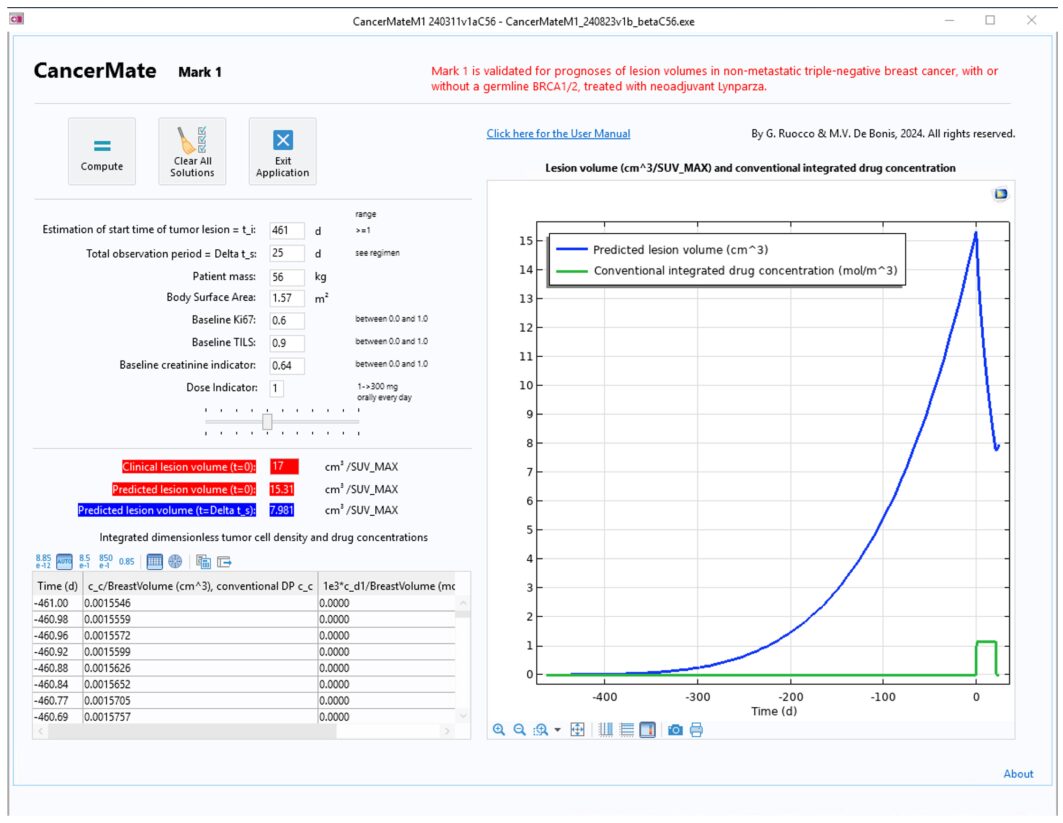
CancerMate provides a dedicated interface through which authorised users can enter the required model parameters, run a simulation and inspect the resulting outputs without interacting directly with the COMSOL Multiphysics front end. The User Manual describes the current workflow, required inputs, available outputs and operating assumptions. It should be read before interpreting any simulation result. … Read More “CancerMate’s Interface and User Manual” »
CancerMate does not treat mathematics as magic or as a black box. Its equations provide a simplified, testable representation of biological processes occurring at tissue scale. Reaction-diffusion equations describe the balance between tumour proliferation, spatial transport and treatment effects. Model parameters can be informed by diagnostic imaging and selected biological measurements, allowing the simulation to … Read More “From Equations to Tumour Dynamics” »
Virtual Human Twins are computational representations of human physiology or pathology designed to support scientific research and, when adequately validated for a defined purpose, healthcare applications. They may combine mechanistic models with clinical, imaging and biological data across different spatial and temporal scales. As new observations become available, a mature twin may be updated to … Read More “Virtual Human Twins and In Silico Medicine” »
COMSOL has published a user story describing how iBMB Srls used COMSOL Multiphysics to develop CancerMate and its reaction-diffusion modelling framework. The article presents the engineering motivation, the retrospective 17-patient study and the development of a simulation interface intended to make the model accessible without direct use of the underlying COMSOL environment. The feature provides … Read More “CancerMate Featured in COMSOL’s User Story Gallery” »